Sunday, February 12, 2012

Aim: How do we graph dilations?


  • Dilation is another main function of the transformations. Dilation: 
                      - is the ratio of an image or figure shrinks or enlarges from its original state of being [original size]. This is also known as a Scale Factor.

This is an example of dilation,
b/c the magnifying glass is making
the print look much bigger
through it's lens.
  • When it comes to graphing dilations, you have to look at the Scale Factor. 
          
In this image ΔABC is dilated
 bigger to form 
ΔA'B'C'.
This shows that the scale
factor is bigger than 1. 


*Hint:

                      -If the scale factor is larger than 1, the image 
                        or figure has been enlarged [made bigger].
                       -If the scale factor is greater than 0 and less than 1, 
                   the image or figure has been shrinked. 


  • When you're trying to solve any problem that has given you the ratio (scale factor) and original image, you multiply the ratio to the points given. 


An example of dilation in
real life. When  a  person is
excited or scared, their muscles
in their eyeballs stretch.


Monday, February 6, 2012

Aim: How do we graph transformations that are reflections ?


  • Reflections is one of the  functions in Transformations. 
  • You can go by the definition of Line Reflection:


                                          - A transformation that creates figures which are mirror images of the original.      
                                         
                     
If you look closely at the bubble,
it shows a line of symmetry going horizontally.
That's why the house looks kind of twisted !


                                    * Trick Rule: -Over the x axis (x,y) -->> (x,-y)   
                                                                           -Over the y axis (x,y) -->> (-x,y)                                                


  • and the definition of Reflection itself: 

                                          - When a figure is flipped over a line of symmetry. 


Mirror Image Prime
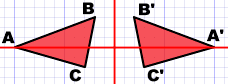
The red line that goes horizontally
is the line of symmetry to the triangle. 


                       So when you transform a figure by reflection, you use the Line Reflection rule on the point(s). 


Now try it, with this ! *pointing down*