Showing posts with label areas. Show all posts

Sunday, March 25, 2012

March 17: How do we find the area of regular polygons? (AIM)

Aim: How do we find the area of regular polygons? 


  • Regular polygons are polygons with all sides and all angles equal.

  • Some examples usually used as regular polygons are:

  • Pentagons - 5 (1/2 x a s)
There are 5 equal
triangles, with equal
side lengths. 

  • Hexagons - 6 (1/2 x a s)


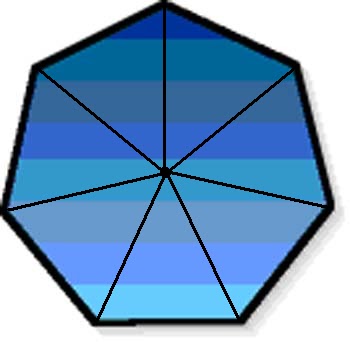
  • Heptagons - 7 (1/2 x a s) 

  • But there's a shorter way to know this. Also remember that in any case n is number of sides, s is side length, and a is apothem [distance from center of polygon to the side].

This table shows that
the formula is 1/2 times
the # of sides, apothem,
and side length. 

  • Also there's another rule for finding the area of a regular polygon. It's 1/2 x P x a. In this case P is the perimeter and a is the apothem. 


  • Now try this problem:


  1. What is n and the areas of this figure? 


Sources Cited:

  1. John Schnatterly AKA -->  http://johnschnatterly.blogspot.com/
  2. http://mathcentral.uregina.ca/QQ/database/QQ.09.07/h/jenna2.html
  3. http://www.kathykwylie.com/blog/2010/10/geometric-shapes-in-quilts-hexagons/
  4. http://mryipsmathclass.blogspot.com/2010_11_01_archive.html
  5. http://www.trueknowledge.com/q/facts_about__pentagon

March 20: How do we find the area of a circle? (AIM)

Aim: How do we find the area of a circle?


  • A circle is known as a round plane figure whose boundary (the circumference) consists of points equidistant from a fixed center. 

  • There are circles EVERYWHERE, seriously. Look at anything right now, & i will guarantee you can find a type of circle. For example is you have the iPhone, here's some circles on your phone (that you probably never let go of) :


These are just SOME circles
on the iPhone. Even the circles
i drew on there are CIRCLES man !

  • Now when finding the area of a circle, its just a little tricky. This is because there's 2 formulas for a circle. There's circumference (perimeter for circles) & area, but they're 2 different things. But they do have one thing the same, PI. 

  • For circumference, you multiply the radius by 2 or multiply the diameter by Pi. Or go by the rule of either 2πr or πd. Either way they're both the same. 

  • For area you'll square the radius and multiply it by Pi. Or the rule is  πr².


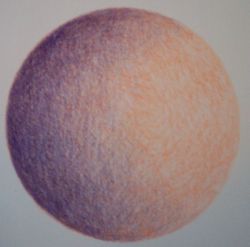
The pink/purple shaded
part of the circle (inside),
is the area of a circle.
  • Here's an example of finding the area & circumference of a circle :


  • So now that you've got everything packed down on area & circumference ... try this problem out :


  1. What is the area of the colored part this circle ? 


Sources Cited:


Saturday, March 17, 2012

March 15: How do we find the area of parallelograms, kites, and trapezoids ? (AIM)

Aim: How do we find the area of parallelograms, kites, and trapezoids ?


  • The area of a shape is the amount of space inside the boundary of a flat (2-dimensional) object. 


  • On that link you can watch the video, try the activity, take a quiz on it, & etc. But I will still try to explain it here. 

  • The area for a parallelogram is probably the easiest. Just because you only have to multiply length and height (l x w). But there is an easier way to look at it. 
 

  • Now the area of a kite is very different. You have to multiply the 2 diagonals and then divide that by 2. ((d1 x d2) / 2)
 

  • The area for a trapezoid is kind of similar to the kite's, but instead of diagonals there are bases & a hieght. In this case you add the 2 bases and then multiply that by the half of the height. 


Tuesday, March 13, 2012

March 12: How do we calculate the area of rectangles and triangles? (AIM)

Aim: How do we calculate the area of rectangles and triangles?


  • Well for starters, the are of a rectangle is very different from the area of a triangle. 


  • The area of a triangle has a formula like this:

Area would equal
1/2 times the base
and height.


  • The area of a rectangle has a formula like this:
The length is multiplied
by the width.

  • Sometimes in a question, you'll get a shape that looks kind of funny. But if you break it down, there might be a triangle or/and a rectangle. For example in this problem:


What would be the area
for this figure? 

  • So you would break it down like this:

Let's break it down into two parts.
Part A is a rectangle,
& Part B is a triangle. 

  • Part A is a square:
  1. Area of A = w x h = (20m) × (20m) = 400m²

  • Part B is a triangle: 
       Area of B = ½(b × h) or (b × h)/2 = ½ × (20m × 14m) = 140m2

  • Now to find the area of that figure you saw earlier, you add the 2 areas:
       Area = (Area of A) + (Area of B) = 400m2 + 140m2 = 540m2 
 

                                                      Now you try it !


  • What is the area of this triangle ?
  1. 30
  2. 90
  3. 56
  4. 28


Sources Cited:
  1. http://www.math-worksheets.info/2010/06/worksheets-area-triangle/
  2. http://ed101.bu.edu/StudentDoc/current/ED101fa09/arl2013/Area.html
  3. http://www.mathsisfun.com/area.html
  4. John Schnatterly AKA -->  http://johnschnatterly.blogspot.com/