Showing posts with label conditionals. Show all posts

Sunday, March 4, 2012

Aim: How do we solve logic problems using conditionals?

Aim: How do we solve logic problems using conditionals?


  • Well when solving logic problems using conditionals, you have to use any conditional right.
                                            - a conditional is a most used statement in an argument of math.  
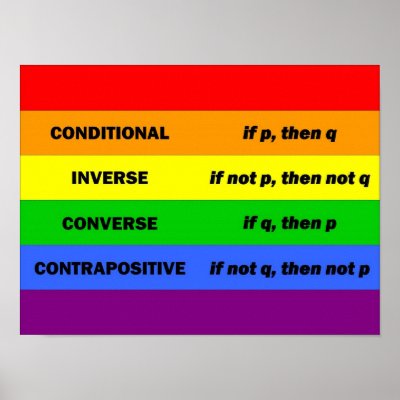
  • There are four conditionals, they are :
  1. Conditional( = Converse)
  2. Inverse (same as Contrapositive)
  3. Converse ( = Conditional)
  4. Contrapositive (same as Inverse)
  • But there's also Biconditional, which is when both conditional & converse are TRUE.

  • When dealing with conditionals you have to identify the hypothesis and conclusion of a conditional.


  • Now Try it with this little segment !


1
.


Which of the following statements is the converse of
"If the moon is full, then the vampires are prowling."?
Choose one:
 If the vampires are prowling, then the moon is full.
 If the moon is not full, then the vampires are  prowling.
 If the vampires are not prowling, then the moon is not full.
(correct answer: 1) 

Sources Cited:

Aim: What is logic ?

Aim: What is logic?


  • Logic is thinking ! Its the tool to determine between whats true & whats false. 

  • Logic is using proofs to prove that the truth is being told in a composition. 
This shows how subjects go
from converse and inverse.

  • You can also use Conditionals to solve logic problems. But you have to make sure you use the right one. A conditional is :
                            - a most frequently used statement in an argument or in the study of math           (ie.geometric proofs)        


  • There are also different types of conditionals and more ! 
These are the four types of Conditionals.

  • To help explain this a little bit more, here's a brief statement on conditionals.


  • But for now, just try this little logic problem to get that noggin working !


  1. How would you write a conditional statement from the hypothesis of "three and five are combined" and the conclusion of "it is equal to eight" ?
  • a) If it is equal to eight, then three and five are combined.
  • b) If three and five are not combined, then it is not equal to eight.
  • c)If three and five are combined, then it is equal to eight.